A calm, practical way through family change
Professional Family Mediation
Separation, divorce, and family transition touch the practical rhythms of daily life and what matters most — children's sense of security and the adults' ability to move forward without constant conflict.
Barker Mediation offers a steady, human-centred approach that helps families make practical decisions they can genuinely live with. We support couples, co-parents, and extended families across the UK to find durable solutions grounded in the realities of day-to-day family life.
100%
Voluntary — you remain in control at every stage
UK
Supporting families across the United Kingdom
Mediation is not about winners and losers. It is about making decisions you can live with — decisions shaped by the people who matter most to your family.

Clear plans equal fewer uncertainties. Predictable schedules benefit both adults and children, reducing sudden disputes and making everyday life more manageable for everyone in the family.
Mediation often resolves matters considerably faster than litigious court processes because it concentrates on agreed, practical everyday solutions rather than legal argument. Families can move forward with clarity and confidence sooner.
Decisions made by the family are more likely to be durable because they have been worked out by the people most directly involved. There is no third party imposing an outcome — the agreements belong to those who made them.
Mediation provides a structured, safe space for concerns to be expressed and heard. By reducing ongoing conflict, it helps preserve relationships where possible — and protects children from the emotional burden of protracted adult disputes.
Mediation is built around practical compromise, not perfect outcomes. It is designed so that the families involved can proceed with agreements that work in the real world — ones that reflect genuine needs and daily constraints rather than abstract ideals.
Mediation focuses on arrangements that fit into the everyday patterns of family life — school timetables, work schedules, and daily routines. Long-term agreements formed this way are far more likely to succeed and to be followed in practice.
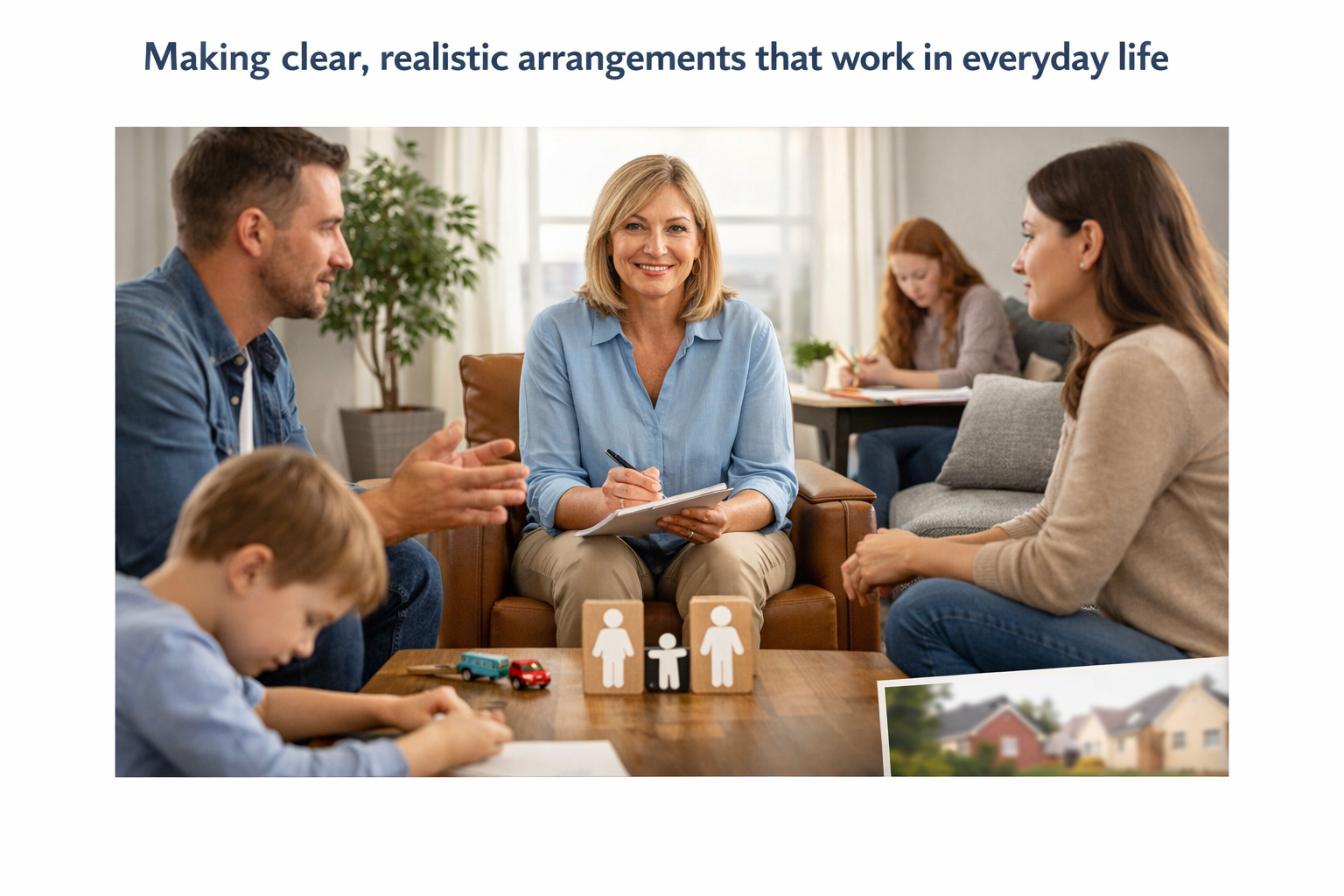
A clear, structured process that respects your time and focuses entirely on reaching practical agreements that support daily family life.
A private conversation helps determine whether mediation is suitable for your circumstances. What each person hopes to achieve may also be explored at this stage. This initial discussion is confidential and provides an opportunity to ask questions and understand the process fully before making any commitment.
Once both parties agree to proceed, a short agreement is signed. This explains the process, the mediator's role, and the nature of confidentiality. It is not a legal contract — it is simply an agreement to participate constructively in the mediation process.
Each party considers the practical points they wish to discuss and gathers any useful documents — calendars, notes of current arrangements, or school term dates. Preparation focuses on what practical outcomes are needed, rather than on building legal arguments. This groundwork makes sessions more productive and focused.
Structured, focused sessions may bring both parties together or — where preferred — take the form of shuttle or separate meetings. Throughout, the mediator helps translate concerns into practical choices, facilitates negotiation, and keeps discussions child-centred where arrangements for children are involved.
When decisions are reached that both parties can live with, the mediator summarises them in clear, accessible language. Where appropriate, a simple parenting plan or written summary of practical arrangements is prepared — a practical tool designed to guide day-to-day family life going forward.
Arrangements often include a date or condition for review so that plans can be adjusted as circumstances change. Reviews are a normal and healthy part of good planning — they reflect common sense and the understanding that family life evolves over time. Parties can also return to mediation if adjustments become necessary.
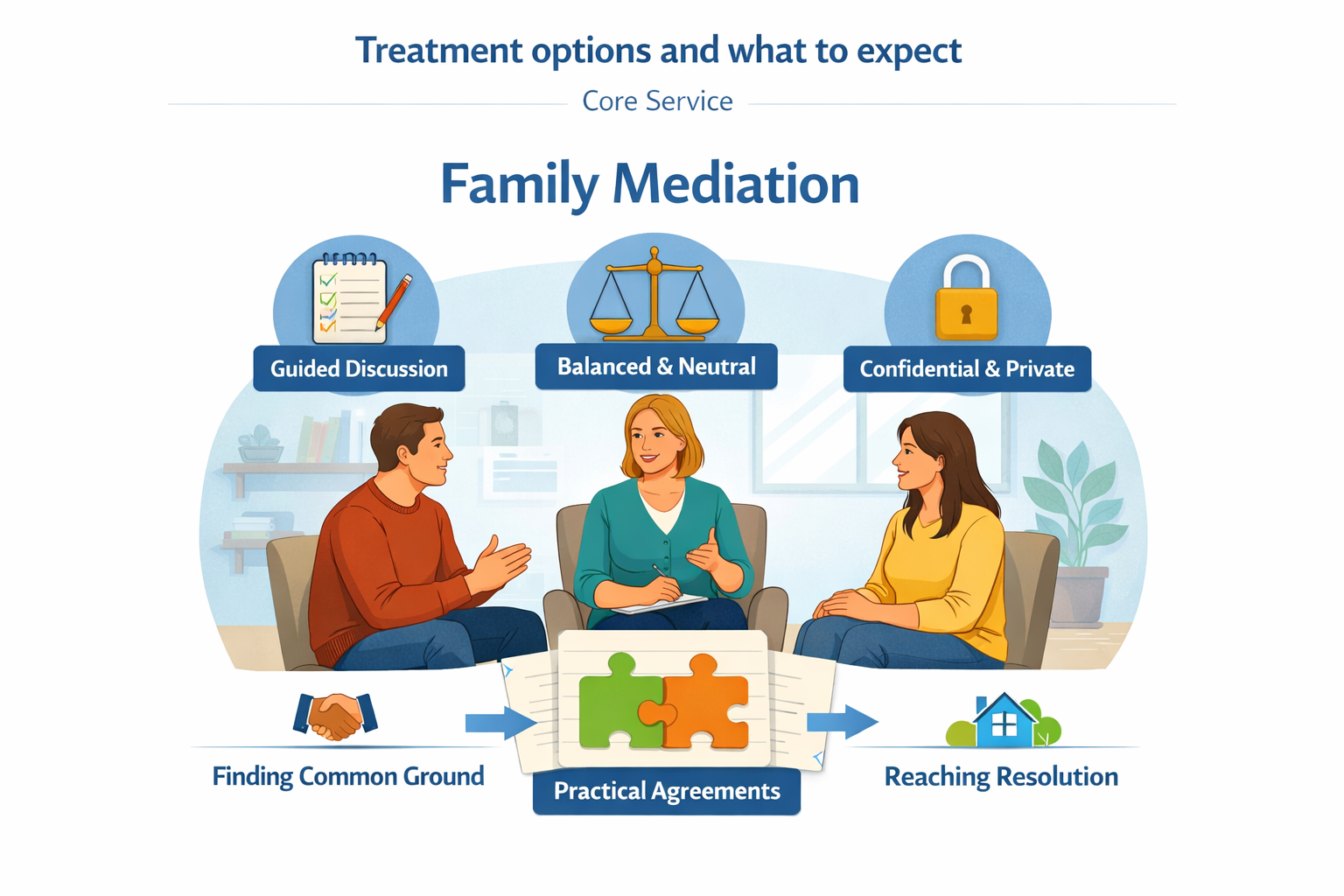
We help separating partners work through the practical arrangements that follow separation so their lives can become less stressful and more predictable. Work is grounded in everyday realities: sorting routines, agreeing responsibilities, and planning the early arrangements so that children's daily needs remain safeguarded throughout.
Parents who continue to co-parent — from the same home or from separate households — find mediation a constructive place to agree on arrangements that work across school terms, weekday rhythms, weekends, and holiday periods. The focus is always on reducing conflict in children's everyday lives.
Whether children are very young, in primary school, or older teenagers, mediation focuses on predictable routines, clear communication, and plans that support children's well-being. Discussions consider how arrangements will work in practice for school runs, homework, after-school activities, and transitions between homes.
Blended families bring complex rhythms and responsibilities. Mediation helps all adults involved think practically about routines, boundaries, and the particular needs of children across multiple households, supporting clearer communication and more consistent arrangements for everyone involved.
Mediation can help families resolve disagreements about care, living arrangements, and responsibilities for older relatives. The focus is on finding practical solutions that preserve family relationships wherever possible and reduce the stress of unresolved conflict around difficult decisions.
For many, mediation is a less adversarial and more constructive way to resolve family matters than pursuing decisions through the court system. It can be quicker, less stressful, and entirely focused on reaching realistic, everyday arrangements — without the formality or expense of litigation.
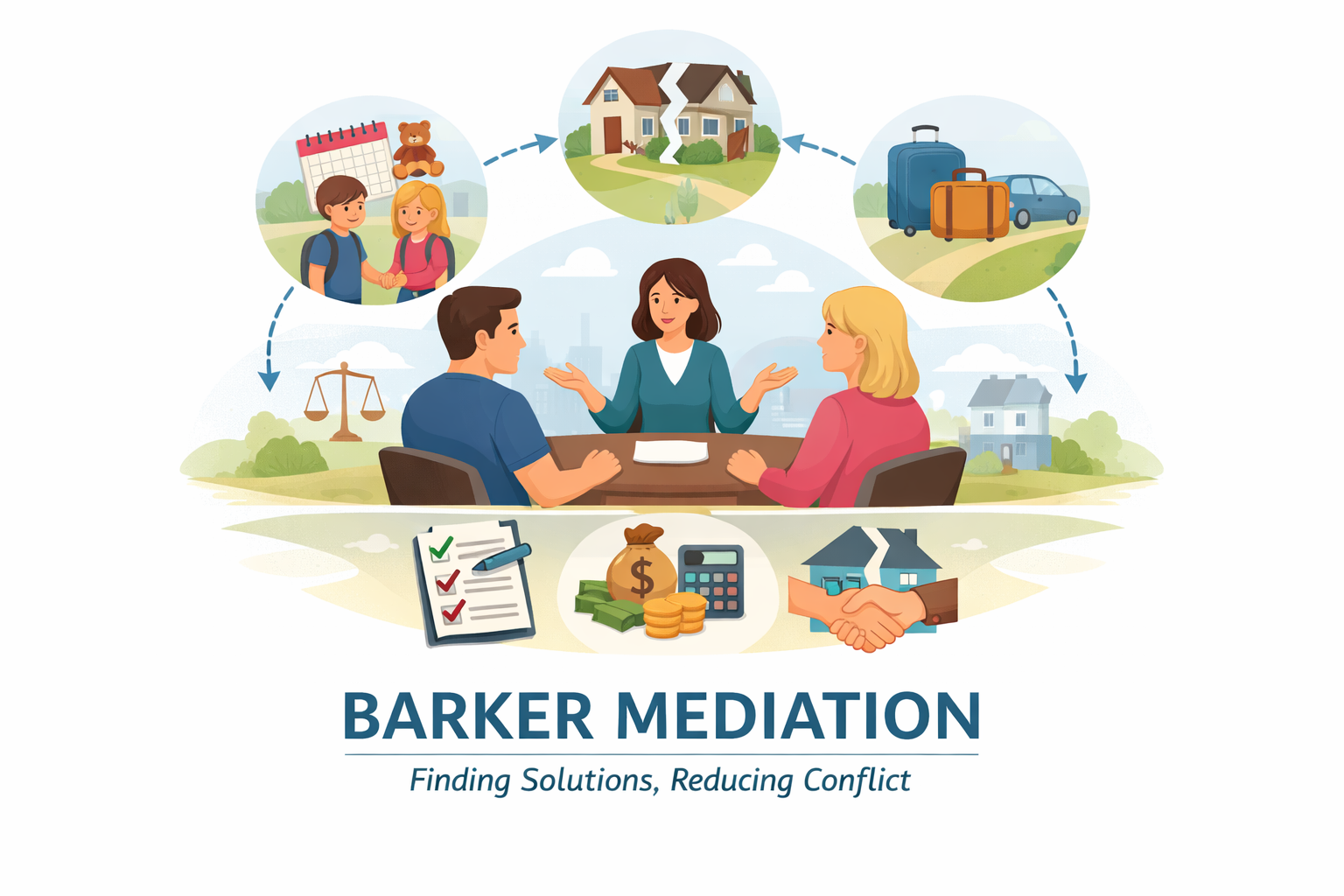
Core Service
A structured series of meetings with a neutral mediator to help people discuss and agree on family arrangements. Sessions are confidential and carefully facilitated so that both parties are heard and practical agreements can be formed.
Child-Centred
A way to make decisions centred on children's needs — including routines, schooling, and contact arrangements. Discussion is guided by what will work best for children's daily lives, with realistic and clear proposals for how care is shared.
Written Plans
A practical written plan setting out who does what and when, designed to reduce confusion and conflict in everyday co-parenting life. The plan provides a sensible, flexible framework that both adults can follow day to day.
Financial
Help to identify, prioritise, and agree on how household resources and responsibilities will be managed after separation. Practical steps and decisions about the division of responsibilities are arranged so they fit normal household routines and ongoing commitments.
Remote Access
Mediation by secure video or telephone when face-to-face meetings are not possible or preferred. The same structured process is adapted for remote participation, with careful attention to both safety and privacy throughout.
Separate Rooms
When parties prefer not to be in the same room, mediators can work between separate rooms or speak individually with each person. This approach provides mediated communication that protects personal space and safety while making meaningful progress towards agreement.
Mediation produces arrangements rooted in the realities of everyday family life — not idealised outcomes that are unlikely to hold in practice. The goal is agreements both parties can genuinely commit to and sustain.
Mediation is designed around practical compromise. Neither party may achieve everything they initially wanted, but agreements are shaped to be fair, functional, and liveable — reflecting the needs of the whole family, especially children.
Success is measured by whether arrangements reduce everyday conflict, provide predictable routines for children, and help adults manage their responsibilities with greater ease. Clear plans translate directly into calmer family life.
Life changes. Agreements reached in mediation often include provision for review, so that arrangements can be revisited and adjusted if they are no longer working well. Flexibility is built in from the outset.
Mediation itself does not automatically create a legally binding agreement. Agreements reached can, however, be recorded in writing and — if both parties wish — converted into legally enforceable documents with independent legal advice and the appropriate legal steps.
Beyond the specific arrangements agreed, mediation often helps establish clearer patterns of communication between the adults involved. This foundation makes future co-parenting or co-operation considerably easier and less fraught for everyone in the family.

The great majority of what is said in mediation remains within the mediation room. This allows people to explore options freely, test ideas, and have honest conversations without the immediate pressure of legal consequences. Confidentiality is a core feature of the mediation environment and a central reason why participants are able to speak candidly.
There are important exceptions. If information emerges suggesting that a child or adult is at risk of serious harm, the mediator has a duty to take reasonable steps to protect that person's safety. This may include sharing necessary information with appropriate agencies. Mediators explain these limits clearly at the outset — so there are never any surprises.
Mediators do not act as legal advisers for either party. Their role is to explain options and help both parties understand how practical arrangements can work. Where legal or financial advice is needed, parties are actively encouraged to seek independent advice from qualified professionals. Mediators maintain a clear and consistent boundary between their facilitative role and legal guidance.
Mediators hold accredited family mediation qualifications and engage in continuing professional development. Many bring experience from fields including family support, social care, and counselling. Qualifications and experience are explained in plain terms.
Mediators operate within recognised professional standards and training frameworks, adhering to established codes of practice. Where legally binding documentation may be required after mediation, parties are encouraged to seek independent legal advice.
Safeguarding means always putting a child's safety and welfare first. If information emerges that suggests a child is at risk, the mediator explains clearly what steps must be taken — including where confidentiality may need to be set aside to keep a child safe.
Safety is paramount. Where there are concerns about domestic abuse, the mediator discusses the safest way to proceed. This may involve options other than joint mediation, and appropriate safeguarding steps are always taken to protect all parties.
We work to make mediation accessible. This may include flexible scheduling, breaks during sessions, alternative meeting formats, remote options, language support, or other adjustments to support the full participation of every person involved.
Mediation does not end when sessions conclude. Agreements are recorded, reviewed, and — when life changes — adjusted to remain practical and effective.
Agreements reached in mediation are recorded in clear, plain language. This may take the form of a simple parenting plan or a written summary of practical arrangements. The document is designed as a practical tool to guide day-to-day life — accessible and unambiguous for all involved.
Life changes and so do family needs. Agreements often include a date or condition for review, so arrangements can be adjusted if they are no longer working as intended. Scheduled reviews are a normal and healthy part of good planning — they reflect common sense, not failure.
Success is assessed by whether arrangements reduce everyday friction, provide predictable routines for children, and help adults manage their responsibilities more easily. If difficulties arise, the mediator can explain how parties might return to the process for practical adjustments.
Mediation itself does not automatically create a legally binding agreement. Agreements can be written down and, if both parties wish, converted into legally enforceable documents through independent legal advice and the appropriate legal steps. Mediation helps you reach the terms; separate legal procedures are used if a formally binding agreement is required.
No. Mediation does not require solicitors to be present. Some people choose to attend with additional support or to consult a solicitor separately for independent legal advice alongside the mediation process. Mediators do not give legal advice but can help identify areas where such advice may be beneficial.
If one person is unwilling to attend joint sessions, the mediator can suggest alternatives such as shuttle mediation, separate meetings, or other routes to communication. Mediation requires a willingness from both parties to engage in constructive conversations — but it does not always require being in the same room.
There is no single answer. Some issues can be resolved in a small number of sessions, while others require more time. Sessions are typically focused on making practical progress and may be scheduled weekly or at intervals that suit the parties. The aim is always to make the process as efficient as possible while ensuring it is thorough.
Children usually do not attend regular mediation sessions. Where children's views are relevant, these can be gathered through age-appropriate means without placing children in the centre of adult disputes. Any direct involvement of a child is handled with great care and only when it is truly appropriate to do so.
Yes. Mediation can address financial matters and the practical division of responsibilities following separation. For complex financial or legal matters, parties are often advised to seek independent legal or financial advice alongside the mediation process. Mediation and professional advice work well together.
Safety is always the priority. If there are concerns about safety or domestic abuse, the mediator will discuss the safest way to proceed. This may include options other than joint mediation, and appropriate safeguarding steps are always taken. No one is ever required to participate in a process that feels unsafe.
Because mediation is entirely voluntary, anyone can pause or stop the process at any point. Decisions made in mediation are the choices of the parties themselves, and there is no obligation to continue if circumstances change or if the process no longer feels right. Mediators explain this clearly from the outset.
Yes. Parties are free to seek independent legal advice at any stage of the mediation process. Mediators do not provide legal advice themselves, but they can help identify areas where legal or financial input may be helpful and will actively encourage parties to seek that advice when it is needed.
Sessions are not usually recorded. Agreed outcomes are typically written down in a straightforward format agreed by both parties. Any written record is shared only with those involved, unless safety concerns require otherwise. The focus is on producing clear, accessible documentation — not formal transcripts.
Mediation gave us a space to focus on what actually mattered — how our children's week would work in practice. We left with a plan that we could both follow, and the day-to-day conflict reduced significantly almost immediately.
Co-Parenting Agreement
I had no idea how we were going to agree on anything. But the mediator kept us focused on practical questions rather than old grievances. The process was far quicker and less upsetting than I expected, and we reached arrangements we could both accept.
Separation Arrangements
What struck me most was how grounded the whole process was. It wasn't about winning. It was about working out what would genuinely make everyday life better for our children — and it did exactly that.
Child-Focused Mediation
We begin by listening. Our priority is to understand the practical needs of the family and the well-being of children. The aim is always solutions that will genuinely work in daily life — not abstract ideals. Every family's situation is different, and our approach reflects that.
Every conversation is treated with care and discretion. Mediation provides a private space to exchange views and explore options without immediate public or legal exposure — a space in which people can speak honestly and feel genuinely heard.
Mediators do not take sides or give legal advice. The role of the mediator is to ensure that both voices are heard, to identify practical options, and to support realistic decisions. Both parties receive the same quality of attention and support throughout.
Discussions are kept firmly grounded in what will actually help children and adults in their day-to-day routines — school runs, childcare, holidays, finances, and shared responsibilities. Practicality is not a constraint; it is the point.
Mediation is a voluntary process throughout. Parties remain in control of decisions at every stage and choose what, if anything, to record at the end. This sense of ownership makes outcomes more durable and more meaningful.
The mediator's role, the limits of confidentiality, and the practical steps of the process are explained in straightforward, plain language throughout — so that everyone involved can make informed choices with confidence and clarity.
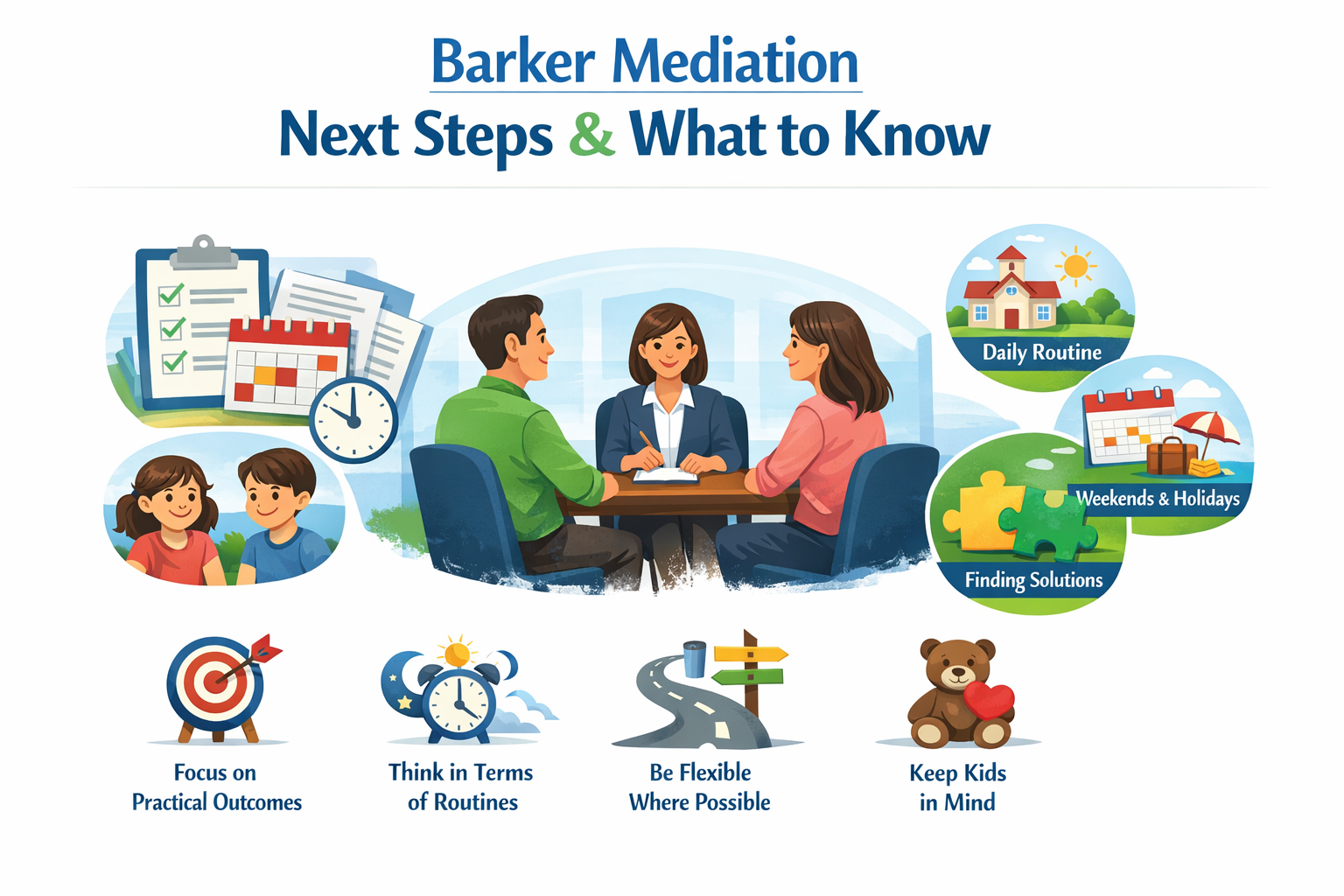
Knowing what to bring and how to prepare makes mediation more focused and productive from the very first session.
Mediation provides a private, practical way to make plans that reduce conflict, protect children's routines, and help adults move forward with clarity. The work is straightforward: listen, identify what matters most, and find sensible ways to organise everyday life so that families can function with less stress.
If you are considering mediation, gathering your thoughts about the practical arrangements that matter most is a constructive first step. Mediation offers a confidential, impartial space to test options and to reach agreements that are both sensible and sustainable for your family.